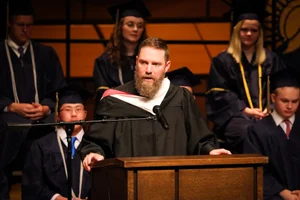
Commencement Address 2026
Welcome parents and students, faculty and staff, neighbors, congregants and parishioners, and all others who are joining us today to celebrate the achievements of these students.
I would like to begin as Aurelius began…with gratitude. I would like to thank the parents of the students seated behind me. Without you, and without you having chosen us, we would never have been let into these lives. We would never have been a part of their stories, and they would never have featured in so many of ours. Everyone who has delighted in them would be less without them. What was most important to you became important to us.
I would like to thank the teachers, and especially perhaps their elementary teachers, for helping to form them into such fine people. The middle-school years are doubtlessly difficult, but the raw material with which we’ve had the happy fortune to experience was developed by the genius and patience of elementary teachers here and elsewhere.
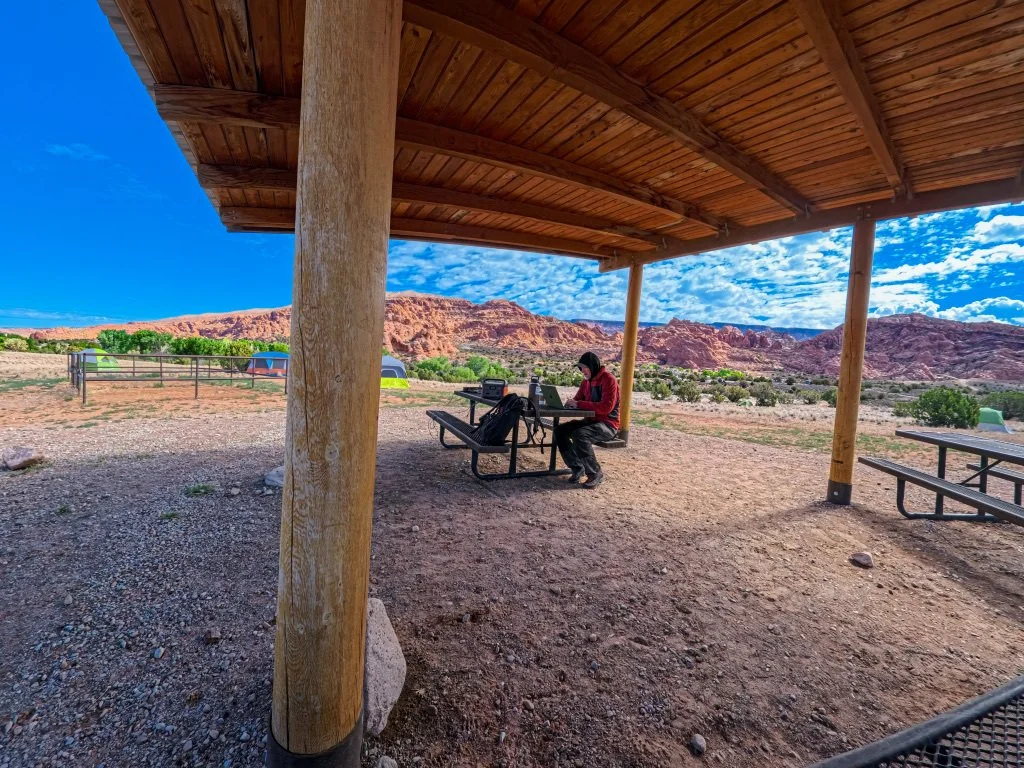
While on the Senior Ruck trip in Moab in May 2026, Headmaster, Mr. Anderson, prepares the 2026 commencement address.
Next, I would like to thank the students themselves for being who they are. I am privileged to have my position and I take it seriously, but one of the regrets that I have about it is that I get to know our students too late. There is much to marvel at in them, and if you are in the business of studying them, you can never say exactly the same thing about any two of them. They are utterly unique. Take Kira. Other students have sung. They have sung well. They have sung beautifully. I will remember them singing and the sound of their voice for as long as I have a memory. None of them have sung as Kira sings. It is not a situation of better and worse. It is that Kira is singular. An improbability, both in her existence and in our intersecting. One popular science calculation has it that there is a 1 in 400 trillion chance that any individual would exist as they are—a 1 in 400 trillion chance that Kira would sing as Kira sings. The odds that I would know anything of her are astonishingly scarce.
For years, I have attributed “known and loved” to a story about Mrs. Carvalho telling students gathered around a campfire what separated Ridgeview from educational experiences they might have had. The basis of this in Psalm 139, which reads: “O Lord, you have searched me and known me!” In researching this, I ran across the following quotation from Timothy Keller, “To be loved but not known is comforting but superficial. To be known and not loved is our greatest fear. But to be fully known and truly loved is, well, a lot like being loved by God. It is what we need more than anything.”
I cannot claim that we’ve known your children as God knows them. Not even as you’ve known them. But, we have, nonetheless, tried in earnest to know each of them. Each of us wants everyone alive to give our children this chance—the chance to be known and loved. Given that the average graduating class size in the U.S. is 150-200 students, and ours is 25, our children stand a better chance of that happening here than most other places.
So, I am grateful for the wild improbability, and I am, paradoxically, happy for the extremely fortunate ratio, which has allowed me to know not just Kira, but 24 of her classmates in substantive ways.
I once listened to a commencement address in which a certain Russian thinker was the thematic link. It made an impression and I thought I had to follow suit. I thought that this event was the obligational opportunity to mark out my intellectual credentials, and that each of these speeches had to be capable of upholding Ridgeview’s intellectual seriousness and weather both critics and time. I cited Thomas More, Samuel Johnson, William Earnest Henley, Edmund Burke, Francis Bacon, and James Madison among hundreds of others. I do appreciate Aristotle, Plato, Alexander Pope, George Orwell, Aldous Huxley, and the rest. I have enjoyed discussing Lermontov, Chesterton, Waugh, Wilde, Koestler, etcetera with the parents, and I am looking forward to discussing George Eliot with our parents this summer, but this event is not about any of these people.
Rather, it has been about this.
It has been about nearly lighting my yurt on fire in Ridgeway, and then throwing blind bad line after bad line until almost noon at an ice park while huffing and puffing in search of the optimum route for our Student Ambassadors to climb. At my hip, hauling rope, carabiners, anchors, and heaven knows what else, was the always buoyant Isabel Troxell. By 11:30, had I been Isabel, I would have thrown me off a cliff, but she just smiled and asked where we would go next. Eventually, the kids were climbing. Isabel and Eli belayed for what seemed like an eternity, and tested routes and knocked down lose ice with aplomb. At around 3:30, Isabel and I took a break at the bottom of the canyon. She looked at me and said, “Well, I think things are going well. How do you feel like they are going?” I said, “words,” that amounted to, “Not great. It’s been a bit of a goat rodeo.” She didn’t blink. She said, “I don’t think so. It’s been great. We were worried there wouldn’t be ice. There’s ice. It’s beautiful, and we are in Ouray. I got to go for a hike, and I learned how to set anchors. Everyone has been climbing for hours and they are happy. It’s all good vibes.” I felt…ashamed. I told Isabel, I think (or I thought it), “You know, you jive better with Miss Grace, but I need you more.” It’s true. And, as Isabel and I later reflected, this was my sixth trip to Ouray with her, and my last. I wanted to either go cry in the truck or fail her thesis to keep her for another year.
Those who know me will say, “That’s just his affinity for Isabel,” and it’s true that she won me over in ninth grade when she skied an entire day at Wolf Creek backwards in order to teach first-time skiers how to ski,” but it wouldn’t explain my affinity for a great many other students.
At her ninth-grade prom, a petite blonde walked into the country club with what can only be described as rock star confidence. She looked, and I do not exaggerate, maybe even down to the mole, like Madonna. White dress—everything. She danced with reserve, ate dinner, the real music started, and she tore off a white skirt, ran onto the dance floor, and was outrageously alive for the next three hours. She must have burned eight million calories. I looked at Mrs. Hayhurst with shock and said, “Who is that girl?” She said, “Lydia Hunter. You’re going to just love her.” Mrs. Hayhurst, as usual, was right. At her senior thesis, Lydia described herself as having always been loud. Mrs. Moessner, her first-grade teacher, nodded in agreement. If there is one thing that I regret not being able to pull off this year, it’s not getting Lydia and Kira in a recording booth. But…I will build it, and it will happen.
Aside from grip strength, a love of Stefan Zweig, or Japanese stationery, one of the things I admire is a boyish boy. I had the pleasure of teaching two of them this year. I would include Will Salter, but he’s too renaissance to be described as boyish, so more on him in a moment.
I usually began Mondays with something to the effect of, “What did you do that was awesome this weekend,” and I concluded Fridays with, “Have fun, don’t die. Come back with stories.” One Monday, Julia and Kira said in response, “We worked on a truck.” “Really?” I said somewhat incredulously. “What did you do?” They said, “We polished headers,” then girlish laughter, and, “Then, we did our nails.” I thought, “What a weird weekend!” The truck in question belonged to Eli Johnson, and I took a much greater interest in Eli once I knew he knew trucks. This was serious work. We had other interactions of course, but one day I was sitting in Mrs. Hayhurst’s office and I saw a student who needed to be “given a talking to” lingering outside. I left her office and confronted the student. He provided an unsatisfactory answer, somewhat unwittingly, which was my opportunity to pounce, and out of nowhere Eli appeared and said, “The truck is here. Do you want to check it out?” “Do I want to look at a truck,” I thought!! Bleep yes. The other kid escaped the noose I’d prepared for him, and I was asking Eli to pop the hood and beaming with pride that he’d had it licensed in Alabama.
The other kid was Oskar. I am still conjuring up ways to get Oskar to come back and ride dirt bikes with me, but my favorite story of Oskar is this. I related to one of his female classmates the following: “Oskar is a GREAT role model for the younger boys. On one trip, he walked around endlessly until the middle-school boys learned how to use a compass. And, on a night hike, one of the younger boys, clearly fan-boying over Oskar pulled a can of Monster from his backpack and said, “Look Oskar!” But, Oskar said, “Dude! It’s like 10:00. You should save that for tomorrow.” I said all of this with immense pride, and she said with a forlorn look, “You know Oskar gave him the Monster, right?” Well, I still love him.

Headmaster Mr. Anderson and Mrs. Douglas record the audio version of the commencement address for podcast distribution.
I convened what I jokingly called a Star Chamber to get the students opinion about schedule changes, graduation requirements, and much else. On this committee, I put Julia Wood. When our first meeting ended, one of our board members told me, “Those girls were unbelievably professional.” Julia came prepared to meetings to represent the interests of students she will likely never know, she was among the first to cheer for her classmates at the end of theses, and at prom, she was not only the cheerleader for royalty, but she was thoughtful enough to acknowledge the wait staff, give their lead a bouquet of flowers, and a hug. At the Winter Ball, she said to me, “You look unhappy. Are you happy? Is this what you imagined it would be?” I said, “I’m nervous. This was hugely expensive. I’m happy if all of you are happy.” She laughed. I think they were happy, but the fact that she noticed my unease is further evidence of what a masterclass she is.
Mikaela Kendall was serious, but intellectually so. She was one of the only students to ask me what else I was reading, and I was happy to have the opportunity to buy her something outside of the curriculum. When I would see her running after school, she had the same look of Stoic composure as she did in the hallways. My first memory of her was skiing behind her at Wolf Creek and admiring her choice of lines through the trees, and telling Mrs. Carvalho that her form was so good that she looked like “one of the rich ladies off the cover of a Vail ski magazine.”
In a quiet moment in moral philosophy, Abby Nauman quietly read aloud a line from Aurelius’ Meditations as though she thought she were using her inside-her-head voice. Amidst the silence, she said quoting Aurelius, “Yesterday’s sperm, tomorrow’s ash. Wow. Heavy.” We all laughed because Aurelius’ comment was so melancholic and discordant with the glint of beauty and optimism Abby brought to our every encounter.
Abby number two of three, Abby Mok was also joyful and quiet, but my favorite moment with her did not arrive until she was doing her senior thesis. I loved that it opened with her talking about baking a lemon meringue pie with her mother. It was both wholesome and human; it’s the kind of moment we all have with people we love, but it’s so small, we aren’t sure why it is the one that became embedded in our memory.
Abby number three of three, Abigail Leveille, was thoughtful and serious. She might only say something once per class, but it was delivered succinctly and with authority. It was what I went home thinking about. If all the chaperones evaporated on a trip, and I had to choose two drivers to move students, it would be Abigail and Mikaela. I was happy to advocate on her behalf at a faculty meeting, and found that the impression she’d made on me was similar to that expressed by her other teachers. She spoke on meaning, peace, and happiness in her thesis, and the note in my book read: “her answers to questions were quietly thoughtful and considerate,” and this has described just about every interaction I have had with her.
Emerson’s thesis surprised me. I did not expect to hear him hold forth on his faith, because he had only ever expressed a more scientific mindset in class. But, it rounded him out a bit for me.
Mateo was the class’s devil’s advocate, and I was grateful for him. The worst thing that can happen in a discussion is for the topic at hand to meet with immediate consensus. The conversation lulls. No one learns. Mateo never permitted this. Sometimes it would seem as though we were on the verge of stalling, and I would look at Mateo with raised eyebrows for help, and he would shrug his shoulders and say, “Ok. Let’s clarify our terms. Are you asking…?”
In grading one of Anna’s assignments with a fountain pen, the paper she had printed it on immediately sucked all of the ink from my pen. When I handed it back to her, she said with consternation, “Who wrote on this?” I replied defensively, “Didn’t you live in France? Where are you getting your paper?” Then, I gifted her a ream of printer paper, and she gifted me a stapler for the class to use. Anna always writes well, but her thesis may have been the one I felt closest to. The dangers of perfectionism. The illusion of control. Seeking inner peace while still pursuing what we believe is important. Anna is far wiser than her years.
Chase is the definition of generosity of spirit. I do not think that I ever saw an unkind or uncivil act from him. He was polite in every encounter, and this made sense when I heard him express his esteem for his grandfather in his thesis, and speak about the importance of both grit and compassion.
Ian and Owen, I was terrified that I would not be able to keep straight, and all I knew of them before teaching them was that I admired their athleticism. Mrs. Hayhurst was so enamored with them that she was promoting them behind the scenes a full year in advance. Owen was the more likely to contribute to the discussion, Ian was the slightly stronger writer…I am pretty sure. Faith was important to both, but Owen’s thesis took up fulfillment and Ian’s addressed community and joy. Both are serious young men, and at least as of the Winter Ball, both are gentlemen.
Will is the class’s renaissance man, and has been a favorite ever since I watched him lead a group of ambassadors through a ridiculous number of burpies at Lory State Park. He knows computers, philosophy, backcountry skiing, cars, and most importantly, more about cars. It was so easy to fall into conversation with Will that I sometimes forgot he was still a student. Hyper-competent, though perhaps even less happy in suffering fools than me, and yet still willing to sacrifice for friends and classmates.
Before I had Cortana, people told me that she was “artistic.” I didn’t know what that would mean for moral philosophy, but it meant that she would quietly sketch in a notebook, volunteer an insightful comment about once a week, and that I was uncertain of whether she understood what we were reading, but…her penmanship was the best in the class. And, when she chose and dedicated a song to her father at the final music concert of the year, then performed it with her peers, I was so impressed with her that I knew that “artistic” had always been a compliment.
Peter has not had an easy situation, which he took up in his senior thesis. I think that if I had encountered Peter as another teacher might have, and not been privy to any private information, I would never have known. He did not appeal to it, he did not lean in on it, he just did the work, made intelligent comments, and argued aggressively with Mateo. In his thesis, he discussed strength and resilience, and Peter has demonstrated both with absolute class.
Ben was quirky and too quiet in class, which initially surprised me, and then eventually I became a bit resigned to it. Then, I saw Anything Goes. Later, when I was complimenting Mrs. Halseide, she said, “I had one student who could do anything, and another who would do anything.” It was the perfect description. I do not think I will ever forget that show. I went home and watched Hollywood versions, and Ben’s acting was on par or better. I joked with my daughter that, “Ben moved in ways I could not have imagined were possible, and it seemed as though even his hair had been double jointed.” Hilarious? Absolutely, but also brave in a way that I don’t think I’ve ever been brave.
John, all too quiet John. I tried hard to make conversations with him about golf, and I got a little out of him. Then, one day, I mentioned something about how I thought it was important that Ridgeview students experience the world and know people outside of Ridgeview, and John came up to me after class and talked about this. I won’t repeat what he said, but in five minutes of conversation it became clear what moral code John lived by, what he thought was important, and who had shaped him. There is a deep inner life in John, and he will do impressive things without the need for fanfare.
I told my daughter one day, “You know who has a good personality?” “Who?” she said. “Jia,” I replied. “Really? Don’t you think she’s a bit…spicy?” I had not really thought about Jia in those terms. I just thought that Jia was funny because she was so petite and yet whenever anyone, and I do mean anyone, attempted to cajole Jia into doing something, even if that something was an entirely reasonable and mundane, thing, Jia became instantly resistant and shot back a look that whispered, “tread lightly.” She is not to be underestimated, and yet, left alone, undisturbed, she was unfailingly polite.
Juliana, who I will not forget here or ever, should have been on this stage with us today. That she is not is a great tragedy. Her optimism and fullness of life was an inspiration, and her desire to be at Ridgeview until very near the end was astonishing. She was bright, energetic, friendly—as full of life as any of you. She loved Ridgeview, her teachers, her pets, her family—she was full of love, and she was lovely.
Colten was too quiet in class, but the first to say thank you. Never failed to say hello in passing. Seemed genuinely appreciative for the trip to Moab. He took up the difficult subject of wisdom in his thesis, and what he said about “what initially feels easy, eventually feels empty” fits well at a school that boasts of doing hard things.
This brings us to the end of the alphabet, to Z, to Zephyr Sadler. Musician, actor, artist. Happily waving in passing even when I thought I might have to burn him down for late work. Thoughtful in class, talented on the stage, great at bouldering, always easy to talk with. He spoke about curiosity, authenticity, and balance—none of these are out of place with who Zephyr has been and tried to be at Ridgeview.
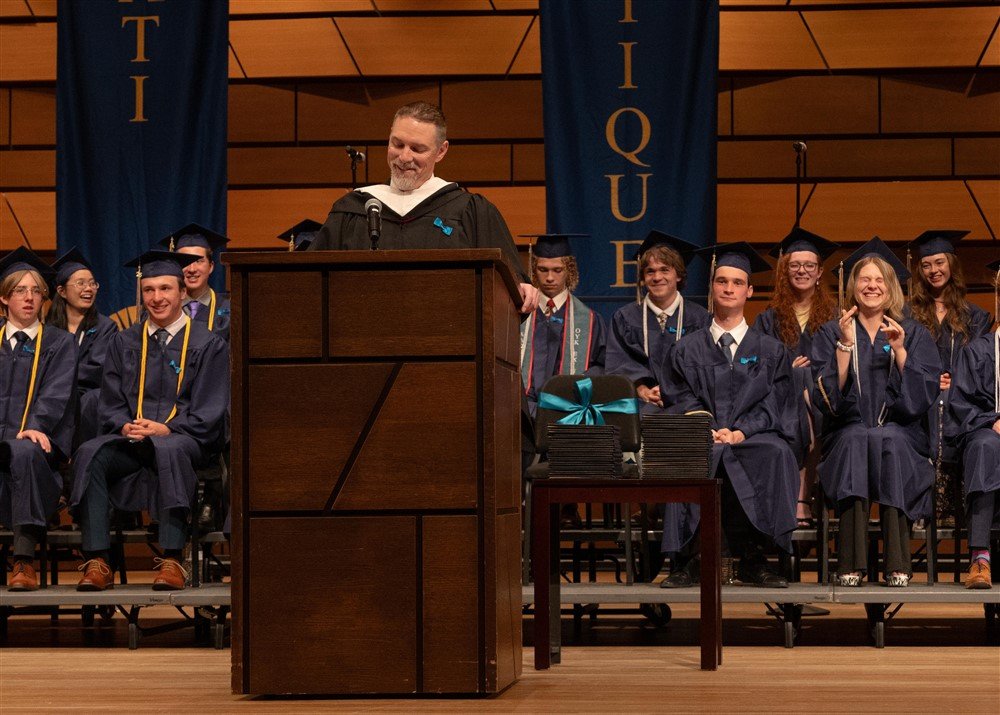
Headmaster Mr. Anderson delivers the commencement address to the Class of 2026 during the graduation ceremony.
It is said that a good commencement address does a few things. It congratulates and celebrates. We have celebrated you with honors and awards, feted you at a senior banquet, and enjoyed one last outing together in Moab despite all of us being sick.
A good commencement provides inspiration and perspective. Hopefully, each of you can point to multiple people in this hall who have inspired you and provided you with a perspective on life. But, as importantly, you have provided us with inspiration to continue in this profession, to continue to fine tune what we do, and to offer each group of students something better that what we have given you.
It is supposed to impart philosophical or practical advice. My big philosophical advice is this: do not take people for granted. It’s the relationships that will mean the most. As we read in Aurelius, whatever you choose to be, you have to be without it being contingent on externalities. If you choose kindness, it cannot depend on the perfect set of circumstances, reciprocation, or quid pro quo. It’s hard to meet people where they are and live by this. It is hard to love people who don’t love us back; it is hard to maintain positive intent when the jaundiced assign everything ill intent, and it’s hard to do good without the expectation of receiving it in return. The world will frequently regard being virtuous as being foolish, and with some people, at least some of the time, it will feel like you are trying to tie their shoes while they are kicking you in the face. Meet the indifference and opposition of the world, believe enough in your principles to sacrifice for them, compliment and praise even when it feels as though it’s unheard, and have the kind of patient, caring, affectionate, gift-love for one another that others have had for you.
It is supposed to create a memorable, shared experience. Your time at Ridgeview, cumulatively, has been that experience.
Finally, it is supposed to bridge the end of one chapter and the start of another, and it supposed to be between eight to fifteen minutes long. I am now at twenty minutes, the same as a senior thesis, and I am out of time.
Please congratulate the Class of 2026!